
TL;DR: Quick Summary
- What it is: Mixed reality gaming blends virtual objects with your physical space, letting you play games that interact with your actual furniture and walls.
- Market dominance: Meta holds 74.6% of the VR/MR headset market, with 80% of new headsets now shipping with MR-capable color passthrough.
- Key advantage: MR reduces motion sickness, eliminates the isolation of full VR, and makes spatial awareness part of gameplay.
- Verdict: If you already own a Quest 3 or similar MR-capable headset, mixed reality games should be your next download. The technology has matured enough to deliver genuinely fun experiences.
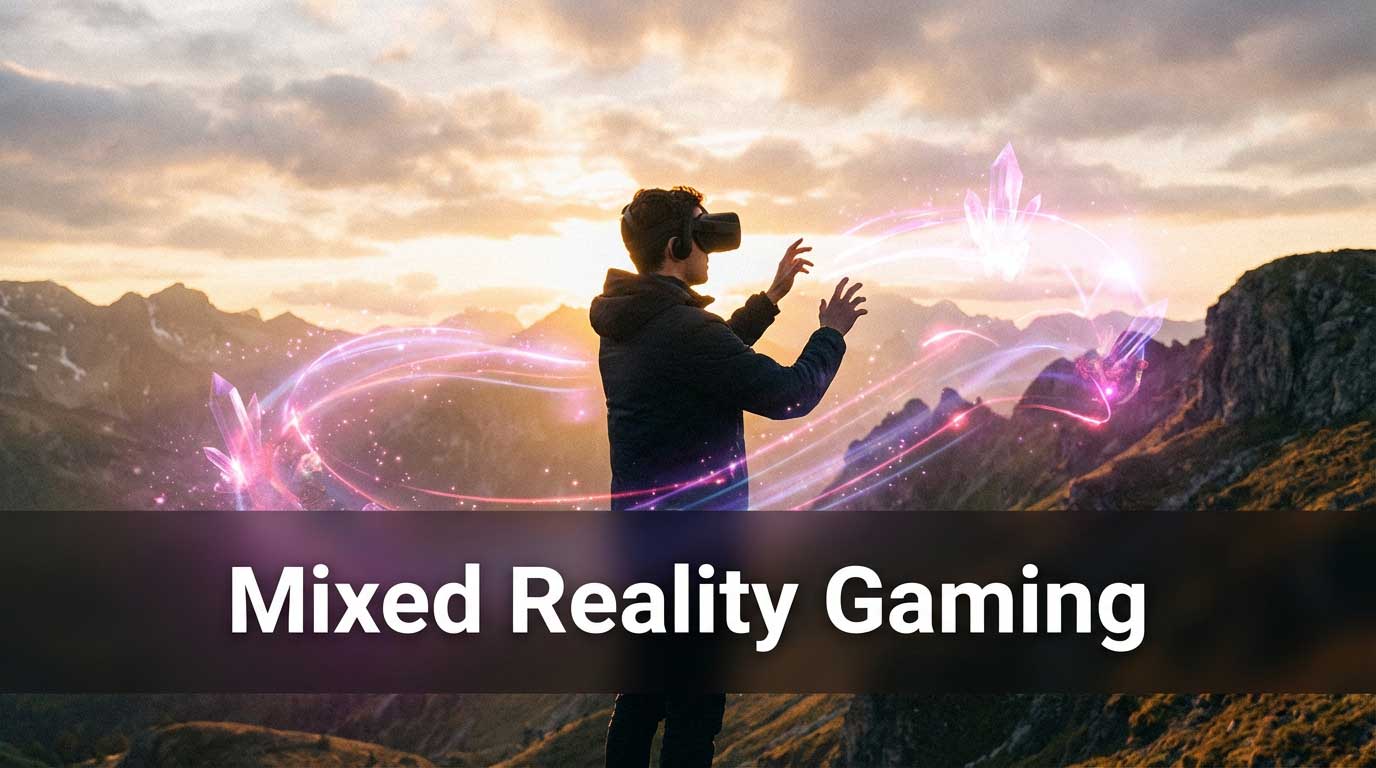
Your living room is about to become a game level. Mixed reality gaming takes the immersion of virtual reality and grounds it in your actual physical space, turning coffee tables into battlefields and walls into portals. Unlike traditional VR, where you’re transported somewhere else entirely, MR brings the game to you.
Mixed reality (MR) gaming combines virtual game elements with real-world environments through color passthrough cameras on headsets like Meta Quest 3. According to Counterpoint Research, 80% of VR headsets shipped in Q3 2024 included MR-capable color video see-through technology, up from just 6% in Q3 2023. This rapid hardware shift signals that MR has moved from novelty feature to expected standard.
This guide explains what makes MR different from classic VR, which games showcase the technology best, and how to set up your space for optimal mixed reality experiences.
What Is Mixed Reality Gaming and Why It Matters
The terminology in spatial computing can get confusing. Virtual reality completely replaces your view with a digital environment. Augmented reality overlays simple graphics onto the real world, like Pokemon GO on your phone. Mixed reality sits between these, blending virtual objects into your physical space so convincingly that they appear to actually exist there.
In MR gaming, your headset’s cameras capture your room in real-time. Software then inserts game elements that respond to your actual furniture, floors, and walls. Aliens might crawl out from behind your couch. A virtual board game might sit on your real kitchen table. The key difference from AR is that MR objects have spatial permanence and physical interaction with your environment.
Core Components of MR Gaming Systems
Modern MR gaming requires several technical elements working together. Color passthrough cameras provide the real-world feed, and higher resolution cameras produce more comfortable experiences. Depth sensors help the headset understand room geometry so virtual objects can properly occlude behind real furniture. Inside-out tracking monitors your position and hand movements without external sensors. The Quest 3 and Quest 3S currently lead the consumer market for MR-capable gaming headsets, while Apple Vision Pro targets a higher-end productivity-focused audience.
How Mixed Reality Gaming Differs from Classic VR
The practical differences between MR and VR gaming extend beyond technical specifications. They change how you play, who can play with you, and how long you can comfortably play.
Motion sickness drops significantly in MR experiences. Because you can see your real floor and walls, your brain receives consistent spatial cues that match your physical movement. Many players who struggle with full VR find MR games comfortable for extended sessions. We found that even players who typically limit VR to 30-minute sessions could enjoy MR games for over an hour without discomfort.
Meta’s Quest 3 platform dominates the mixed reality gaming market with commanding market share. According to UploadVR, Meta captured 74.6% of the VR/AR headset market in 2025, with the Quest 3 and Quest 3S driving adoption of MR-capable devices. The Quest 3S reached the 11th spot on Amazon’s best-selling video game products list ahead of traditional consoles.
Social dynamics shift too. In full VR, you’re isolated from anyone else in the room. They can’t see what you’re experiencing, and you can’t see them. MR lets spectators watch the action unfold, even if they don’t have their own headset. Some games project virtual elements that align with the player’s view, making it possible for others to participate or at least understand what’s happening.
Best Mixed Reality Games to Try First
The MR game library has expanded rapidly since Quest 3’s launch. Some titles showcase the technology’s potential better than others.
Games That Transform Your Space
First Encounters comes pre-installed on Quest 3 devices and serves as the perfect introduction. Cute alien creatures burst through your walls and hide behind your furniture. It’s brief but demonstrates exactly what MR can do, the moment an alien peeks out from behind your actual couch sells the technology instantly.
Demeo deserves special attention for MR gaming. This tabletop dungeon crawler transforms your coffee table into a detailed fantasy game board. You physically reach down to move figures and roll dice. Hand tracking lets you play without controllers, making it feel remarkably like an actual board game night. The Dungeons & Dragons collaboration, Demeo Battlemarked, earned nominations for Immersive Reality Game of the Year at the 2026 DICE Awards.
For action-oriented players, Spatial Ops turns your home into a laser tag arena. The game maps your room and generates tactical cover positions based on your actual furniture layout. No two play sessions look the same because the level design adapts to whatever space you’re in.
MR Games Worth the Investment
PianoVision appeals to musicians and learners alike, projecting virtual keys and note guides onto real piano keyboards. Living Room, a newer title from late 2024, lets you manage a whimsical ecosystem of virtual plants and animals that inhabit your actual living space.
After testing dozens of MR titles, we found that games designed specifically for mixed reality outperform VR games with MR modes added later. Native MR games consider furniture placement, room lighting, and real-world interaction from the start rather then treating passthrough as an optional feature.
Setting Up Your Space for Mixed Reality
MR gaming works best with some preparation. Unlike full VR, where an empty room is ideal, mixed reality benefits from furniture and defined spaces.
Room Requirements and Layout Tips
You need less empty floor space for MR than for room-scale VR. A minimum of 6.5 x 5 feet works for most games, though 8 x 8 feet provides more comfortable gameplay. The headset needs to see your walls and floor clearly, so avoid playing in completely dark rooms or spaces with large mirrors that confuse the tracking cameras.
Lighting matters more for MR than traditional VR. Passthrough quality degrades in low light, making the real-world feed grainy and uncomfortable. Bright, even lighting produces the clearest passthrough image. Avoid strong backlighting from windows directly behind your play area.
Room scanning technology in current MR headsets creates detailed 3D maps of your environment that games use for spatial interaction. According to Road to VR, Quest 3’s room setup process identifies walls, floors, ceilings, furniture, and doorways, allowing virtual objects to properly interact with physical space. Games can spawn enemies behind couches or place portals on detected wall surfaces.
Choose mixed reality gaming if you:
- Experience motion sickness in full VR
- Want to stay aware of your surroundings while gaming
- Have limited space but interesting furniture layouts
- Want to share the experience with non-headset-wearing spectators
Stick with traditional VR if you:
- Prefer complete immersion in fantasy environments
- Have a dedicated VR room with no furniture
- Play mostly racing, flight sim, or seated experiences
- Want the largest possible game library
The Future of Mixed Reality Gaming
MR gaming is evolving rapidly as hardware improves and developers gain experience with the medium. Several trends point toward where the technology is heading.
Passthrough quality continues to improve with each hardware generation. Current headsets still show noticeable grain and limited dynamic range compared to natural vision. Future devices will narrow this gap, eventually making the real-world feed indistinguishable from looking through a window. When passthrough becomes truly transparent, the line between MR and reality blurs completely.
The AR/VR healthcare market illustrates how MR technology extends beyond gaming into practical applications. Industry analysts project growth from $3.05 billion in 2025 to over $20 billion by 2030, with MR training simulations and therapeutic applications driving adoption. Gaming innovations in spatial computing often transfer to enterprise and medical uses within two to three years.
Multiplayer MR experiences represent an underdeveloped opportunity. Imagine multiple players in the same physical room, each wearing headsets, battling virtual creatures that both can see and interact with. The technical challenges are significant, headsets need to share spatial maps and synchronize virtual object positions, but early experiments show promising results.
Hand tracking is replacing controllers for many MR applications. Reaching out and physically grabbing virtual objects feels more natural than pressing buttons, especially when those objects appear to rest on your actual furniture. As hand tracking accuracy improves, expect more MR games designed around controller-free interaction.
Quick Takeaways
- Start with First Encounters – It’s free, pre-installed on Quest 3, and demonstrates MR capabilities in minutes
- 80% of new headsets ship with MR features – Color passthrough has become the industry standard, not a premium extra
- Good lighting beats empty space – MR works better with furniture to interact with, but needs bright, even lighting for clear passthrough
- Hand tracking is the future – Games like Demeo show that controller-free MR creates more natural experiences
Conclusion
Mixed reality gaming represents a genuine evolution beyond traditional VR, not just a gimmick or marketing term. By anchoring virtual experiences in your physical space, MR solves real problems like motion sickness and social isolation while creating gameplay possibilities that full VR simply can’t match.
If you own a Quest 3 or similar MR-capable headset, download First Encounters today if you haven’t already. Spend 15 minutes with it. Watch an alien peek around your furniture. That experience will show you exactly why MR matters more than any article can explain.
The living room gaming setup of the future isn’t about bigger TVs or faster consoles. It’s about your entire room becoming the game. Mixed reality makes that possible right now, and the technology is only getting better.
About the Author
The SimsAgora editorial team specializes in VR, spatial computing, and immersive technology. We test headsets, games, and emerging XR platforms to help enthusiasts make informed decisions. Our coverage spans gaming applications to enterprise use cases across the extended reality spectrum.
Frequently Asked Questions
Mixed reality gaming blends virtual game elements with your physical environment using passthrough cameras on headsets like Meta Quest 3. Unlike full VR, which replaces your surroundings entirely, MR lets you see your real room while virtual objects, characters, and effects interact with your actual furniture and walls.
You need a headset with color passthrough cameras. The Meta Quest 3 and Quest 3S are the most popular consumer options for MR gaming. Apple Vision Pro also supports MR but targets productivity users at a much higher price point. Older headsets like Quest 2 have limited grayscale passthrough that doesn’t work well for MR games.
Neither is universally better. MR reduces motion sickness, maintains spatial awareness, and allows spectators to participate. VR offers complete immersion in fantasy environments and has a larger game library. Many players enjoy both, choosing MR for social or active games and VR for deep single-player experiences.
Most MR games work in spaces as small as 6.5 x 5 feet, though 8 x 8 feet provides more comfortable gameplay. Unlike VR, you don’t need an empty room. MR games actually benefit from furniture since virtual objects interact with real surfaces. Good lighting matters more than total square footage.
Start with First Encounters, which comes pre-installed on Quest 3 and demonstrates MR capabilities perfectly. Demeo offers excellent tabletop gaming with hand tracking. For action games, try Spatial Ops or Espire 2. Living Room provides a relaxing MR experience managing virtual ecosystems in your actual space.